How to Avoid Structural Silicone Degradation: The Definitive Guide
The integrity of the modern building envelope relies heavily on the performance of high-modulus, weather-resistant bonding agents. Within the realm of architectural glazing and curtain wall systems, structural silicone sealant acts as the silent, essential load-bearing element that transfers wind loads and thermal stresses from the glass to the building frame. Despite its reputation for longevity, this material is not immortal. How to Avoid Structural Silicone Degradation. The gradual loss of physical properties—adhesion, elasticity, and tensile strength—represents a significant risk to both fiscal assets and life safety.
Understanding the complexity of chemical and mechanical breakdown requires moving beyond the surface-level assumption that silicone is “set and forget.” In reality, the environment is a relentless adversary. Ultraviolet radiation, hydrolysis, and substrate incompatibility work in concert to undermine the molecular bonds that give these elastomers their unique characteristics. A failure in a single joint is rarely an isolated incident; it is often the symptom of a systemic breakdown in design, application, or environmental assessment.
Addressing these risks demands a rigorous, multi-disciplinary approach. It involves a deep dive into the chemistry of siloxanes, the physics of joint movement, and the logistical realities of high-rise maintenance. This article provides a comprehensive examination of the strategies required to maintain the structural health of silicone joints, shifting the focus from reactive repair to proactive, long-term preservation.
Understanding how to avoid structural silicone degradation
To truly grasp how to avoid structural silicone degradation, one must first discard the notion that degradation is a singular event. It is a cumulative process. Most industry professionals oversimplify the issue by focusing solely on UV resistance. While silicone’s inorganic backbone (Si-O-Si) is inherently more stable under ultraviolet light than organic polymers like polyurethanes, it is not immune to the mechanical fatigue that accompanies UV-induced surface hardening.
The risk of oversimplification often lies in the “compatibility” check. A sealant may be chemically compatible with a gasket at room temperature in a lab, but under the heat of a South-facing facade reaching 160°F, plasticizer migration can accelerate, leading to a loss of adhesion that was never predicted by standard data sheets. Avoiding degradation is therefore an exercise in predicting the synergy between environmental stressors and chemical interactions.
True prevention involves three layers of defense:
-
Chemical Stability: Ensuring the polymer chain remains intact and free from external contaminants.
-
Adhesive Persistence: Maintaining the bond at the interface between the sealant and the substrate (glass, aluminum, or stone).
-
Mechanical Resilience: Managing the joint geometry so the material never exceeds its rated movement capacity, even as it ages and becomes less flexible.
The Evolutionary Context of Structural Glazing
The transition from mechanical glazing—where glass is held by metal stops—to structural silicone glazing (SSG) in the mid-20th century changed the risk profile of buildings. Early formulations were often adapted from general-purpose sealants, leading to inconsistent performance in high-stress environments. The industry eventually evolved toward high-modulus, neutral-cure acetoxy and alkoxy systems specifically engineered for structural loads.
Historically, degradation was often blamed on “bad batches” of product. However, as forensic engineering matured, it became clear that the vast majority of failures were rooted in the systemic evolution of building materials. For instance, the introduction of high-performance coatings on glass and anodized finishes on aluminum created new challenges for adhesion. The history of the field is a testament to the fact that as we push the aesthetic boundaries of transparency and “all-glass” looks, the margin for error in silicone application narrows significantly.
Conceptual Frameworks and Mental Models
To manage the health of structural joints, professionals should utilize specific mental models that go beyond the technical data sheet.
The “Chain Link” Model
View the silicone joint as a series of links: the substrate finish, the primer (if used), the adhesive bond, and the cohesive body of the sealant. Degradation often starts at the weakest link—frequently the interface—rather than the material itself. If the substrate finish is not stable (e.g., poorly adhered powder coating), the silicone will “fail,” even if the silicone itself is in perfect condition.
The Stress-Strain Fatigue Loop
Every cycle of thermal expansion and contraction “consumes” a tiny fraction of the sealant’s total life. In this model, degradation is viewed as a battery that slowly drains. Factors like extreme temperature swings or wind-induced vibration accelerate the drain. Understanding the limit of this loop helps in predicting when a system will transition from the “plateau” of useful life to the “cliff” of failure.
The Incompatibility Matrix
This framework assumes that every material touching or near the silicone is a potential threat until proven otherwise. This includes setting blocks, gaskets, backer rods, and even cleaning agents used by window washers years after construction.
Key Categories of Silicone Systems
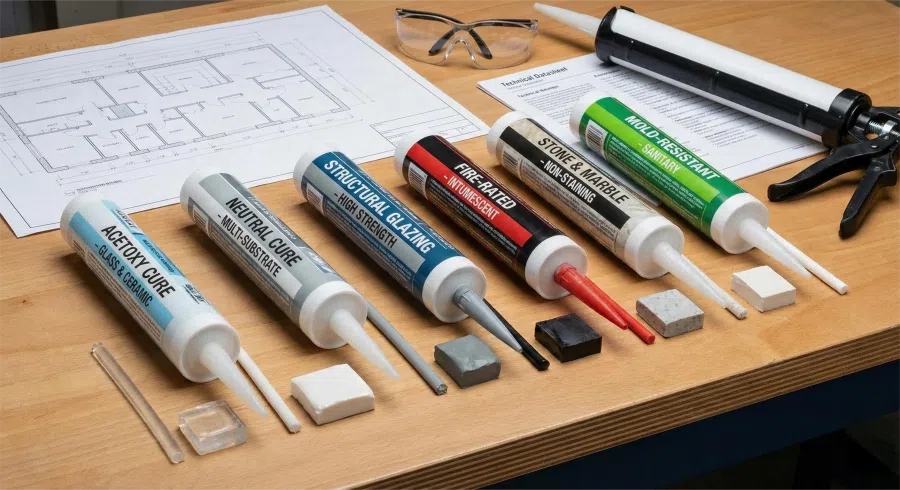
Choosing the right material is the first step in determining how to avoid structural silicone degradation. Not all silicones are created equal, and the trade-offs are often subtle.
| Category | Primary Benefit | Significant Trade-off | Ideal Application |
| One-Part Neutral Cure | Ease of use; no mixing errors. | Slower deep-section cure; skin time varies with humidity. | Field repairs; smaller-scale glazing. |
| Two-Part Neutral Cure | Rapid, consistent deep-section cure. | Requires specialized mixing equipment; potential for ratio errors. | Factory-controlled shop glazing. |
| High-Modulus | Exceptional load-bearing capacity. | Lower movement capability; stiffer joint. | High-wind load areas; structural bonds. |
| Medium-Modulus | Better movement flexibility. | Lower ultimate tensile strength. | Weather seals; joints with high thermal movement. |
Decision Logic for Selection
The logic should follow a “Constraint-First” path. If the project is shop-glazed, a two-part system is almost always superior because it eliminates the variable of atmospheric humidity during the cure. If the project involves a specific substrate like copper or certain types of natural stone, an acetoxy-cure silicone must be avoided to prevent corrosion or staining, which are themselves forms of degradation.
Detailed Real-World Scenarios How to Avoid Structural Silicone Degradation
Scenario 1: The “Hot Box” Effect in Spandrel Areas
In spandrel sections where insulation is placed directly behind the glass, temperatures can soar. If a sealant with low thermal stability is used, the material may undergo “reversion,” where it softens and loses its elastomeric properties. Avoiding this requires specifying high-temperature stable silicones and ensuring adequate ventilation or heat-sink capacity in the frame design.
Scenario 2: Plasticizer Migration from EPDM Gaskets
A common failure mode involves the use of non-compatible EPDM gaskets in proximity to structural silicone. The oils in the EPDM migrate into the silicone, causing it to lose adhesion and turn into a “gummy” consistency. The second-order effect is a complete loss of structural load transfer, requiring a full strip-and-replace of the glazing system.
Scenario 3: The Oversized Joint
To save on material, a contractor might design a joint that is too thin relative to its width. When the building moves, the strain on the thin section exceeds the material’s limit. This leads to cohesive tearing—a permanent degradation of the joint’s physical structure.
Planning, Cost, and Resource Dynamics
The financial reality of avoiding degradation is rooted in the “Rule of Tens”: a dollar spent in design saves ten dollars in construction and a hundred dollars in remediation.
| Resource Level | Initial Investment | Long-Term Impact | Risk Mitigation |
| Standard/Minimum | Low ($) | High maintenance costs; 10-15 year life. | High |
| Enhanced Engineering | Moderate ($$) | Predictable 20-30 year life. | Medium |
| Premium/Authoritative | High ($$$) | 50+ year potential; minimal intervention. | Low |
Indirect costs often overlooked include the “Tenant Disruption Factor.” Replacing structural silicone on an occupied 40-story tower is exponentially more expensive than the material cost itself due to staging, swing stages, and insurance.
Tools, Strategies, and Support Systems
-
Adhesion-in-Peel Testing: The gold standard for field verification. It ensures the bond is stronger than the material.
-
Digital Shore A Hardness Tracking: Using a durometer to track the hardening of joints over decades provides a quantitative “age” for the sealant.
-
Ultraviolet Dosage Modeling: Calculating the specific UV exposure based on building orientation to choose the correct pigment load (Carbon Black is generally most stable).
-
Deglazing Audits: Periodically removing a glass unit to inspect the hidden structural bite.
-
Spectroscopy Analysis: For high-value assets, lab testing of small samples can detect chemical changes before they manifest as physical cracks.
Risk Landscape and Failure Modes
Degradation is rarely a “clean” break. It manifests in a taxonomy of failure:
-
Adhesive Failure: The “clean” peel from the substrate. Usually caused by poor cleaning or improper priming.
-
Cohesive Failure: The material rips down the middle. This indicates the joint was undersized for the movement it encountered.
-
Chalking/Crazing: Surface-level degradation from UV. While often aesthetic, it creates micro-fissures that can harbor moisture and pollutants.
-
Reversion: The chemical breakdown where a solid elastomer returns to a liquid or semi-liquid state, usually due to extreme heat or chemical contamination.
Governance, Maintenance, and Long-Term Adaptation
A layered checklist for long-term health:
-
Annual Visual Inspection: Look for “whitening” of the edges or visible gaps.
-
5-Year Physical Probe: Use a non-marring tool to check for elasticity.
-
10-Year Adhesion Audit: Perform destructive peel tests on representative samples across different elevations.
-
Cleaning Protocol Governance: Ensure that building maintenance crews use only approved, non-reactive cleaning agents. Ammonia-based or highly acidic cleaners can accelerate the breakdown of the silicone surface.
Measurement, Tracking, and Evaluation
Leading indicators tell you failure is coming; lagging indicators tell you it has happened.
-
Leading: Increasing Shore A hardness; slight discoloration; change in surface tackiness.
-
Lagging: Water infiltration; visible tearing; “pumping” of the joint during wind events.
Documentation should include a “Living Manual” for the building facade, tracking every batch number of silicone used and the specific weather conditions during the original application. This allows for targeted inspections if a specific batch is later found to be compromised.
Common Misconceptions and Oversimplifications
-
Myth: “All silicones are UV stable.” Correction: While the Si-O bond is stable, the additives (pigments, fillers, plasticizers) are not.
-
Myth: “Primers are always necessary.” Correction: Many modern silicones are primerless; using a primer on a surface that doesn’t need it can actually create a bond-breaking film if applied too thickly.
-
Myth: “The wider the joint, the better.” Correction: Joint geometry must maintain a specific “aspect ratio.” Too wide a joint can lead to sagging or improper curing.
-
Myth: “Silicone can be applied in any weather.” Correction: Application below 40°F (4°C) risks frost on the substrate, which guarantees adhesive failure as the frost melts and creates a water film between the sealant and the frame.
Conclusion
The pursuit of how to avoid structural silicone degradation is an ongoing commitment to technical rigor. It is not merely about selecting a high-quality product, but about managing an entire ecosystem of materials, environmental stressors, and human factors. As buildings age and climates become more volatile, the role of the structural bond becomes increasingly critical.
By treating the building envelope as a dynamic biological system rather than a static object, architects and engineers can extend the life of these vital elastomers. Success lies in the nuances: the cleanliness of the substrate, the compatibility of the gaskets, and the regular cadence of quantitative monitoring. When managed with this level of depth, structural silicone remains one of the most reliable tools in the modern architectural arsenal, capable of securing the skyline for generations.