The Architecture of Transparency: Iconic Glass Facades USA Guide
The architectural landscape of the United States is defined not by stone or timber, but by the manipulation of light and the engineering of transparency. The evolution of the American skyline is a chronicle of a century-long pursuit to dissolve the boundary between the interior and the exterior. Iconic Glass Facades USA Guide. This trajectory has moved from the heavy masonry of the 19th century to the ethereal, high-performance envelopes of the modern era, where glass is no longer a decorative insert but a primary structural and environmental filter.
Understanding this evolution requires moving beyond aesthetics. To analyze the most significant examples of building envelopes, one must look at the intersection of material science, structural engineering, and urban psychology. The glass facade serves as a mediator: it manages thermal gain, withstands wind loads at extreme altitudes, and reflects the socio-economic aspirations of the city it inhabits.
This exploration examines the technical and cultural dimensions of building skins across the country. It moves past the “glass box” trope to investigate how various systems—from stick-built curtain walls to point-supported structural glazing—have redefined the urban experience. The following sections provide a definitive framework for evaluating the engineering and design of these monumental enclosures.
Understanding “iconic glass facades usa”
The term iconic glass facades usa often evokes images of soaring Manhattan towers or the sleek tech campuses of Silicon Valley. However, an editorial assessment suggests that “iconic” status is rarely achieved through height or shine alone. Instead, true iconicity in the American context is granted to facades that solve a fundamental architectural problem or introduce a paradigm shift in how we perceive transparency.
A common misunderstanding is the belief that glass facades are a monolithic category. In reality, the U.S. market is bifurcated between legacy systems—which prioritize visual clarity—and contemporary systems that treat glass as a complex, multi-layered machine. The oversimplification of “all-glass” buildings masks the reality that these envelopes are often only 40% to 60% transparent when insulation, spandrel panels, and structural supports are accounted for.
Furthermore, the “iconic” label is increasingly tied to performance. In a regulatory environment shaped by New York’s Local Law 97 or California’s Title 24, a glass facade is only as successful as its thermal resistance ($U-value$) and its solar heat gain coefficient ($SHGC$). The risk of oversimplification lies in viewing these facades as purely artistic statements; they are, in fact, the most vulnerable and hardest-working component of a building’s mechanical system.
The Historical Evolution of the Transparent Envelope
The journey toward the modern glass facade in the United States began with the Chicago School. Post-fire Chicago became a laboratory for the “Chicago Window,” a three-part opening with a large fixed center pane flanked by two operable sashes. This was the first major step in liberating the wall from its load-bearing duties, allowing for greater glass-to-wall ratios.
The Rise of the Curtain Wall
The mid-20th century marked the arrival of the International Style, epitomized by the Lever House (1952) and the Seagram Building (1958) in New York. These structures introduced the true curtain wall—a non-structural outer covering that “hangs” from the steel frame. This era established the aesthetic of the grid: vertical mullions and horizontal transoms that standardized the look of corporate America.
The Structural Revolution
By the 1980s and 90s, the focus shifted from the grid to the surface. The development of high-strength silicone sealants and point-supported glass (the “spider” fitting) allowed architects to minimize visible metal. This led to a period of “dematerialization,” where the goal was to make the building appear as a singular, crystalline object.
Conceptual Frameworks and Mental Models
To analyze the efficacy of a facade, one must apply specific mental models that go beyond visual inspection.
-
The Thermal Bridge Model: This framework views the facade as a continuous battle against energy transfer. Every mullion and fastener is a potential leak. Evaluating a facade through this lens forces an understanding of how metal-to-metal contact is broken to maintain interior comfort.
-
The Life-Safety/Resilience Framework: Especially in coastal U.S. cities, a glass facade is a shield against extreme weather. This model evaluates the envelope based on its “design pressure”—how much wind load it can take before the glass deflects or the seals fail.
-
The Occupant Wellness Model: This considers the “visual light transmittance” ($VLT$) and its impact on human circadian rhythms. A facade is not just a wall; it is a light modulator that affects the productivity and health of those inside.
Categorization of Glazing Systems and Material Trade-offs
The diversity of iconic glass facades usa can be categorized by their assembly methods and the resulting architectural expression.
| System Type | Primary Benefit | Trade-off | Typical Context |
| Unitized Curtain Wall | Speed of installation; high quality control | High initial shipping/logistical cost | High-rise urban towers |
| Stick-Built System | Low shipping cost; adaptable to site changes | Labor-intensive; weather-dependent assembly | Low-to-mid-rise commercial |
| Point-Supported (Bolt) | Maximum transparency; minimal framing | Very high cost; complex engineering | Atriums, lobbies, flagship retail |
| Double-Skin Facade | Superior thermal/acoustic insulation | Significant loss of floor area; high maintenance | High-performance institutional |
Decision Logic: Material Selection
When selecting a glazing makeup, the decision is rarely about the glass itself, but the coatings applied to it. Low-Emissivity (Low-E) coatings are standard, but the choice between a “hard coat” (pyrolytic) and a “soft coat” (sputtered) involves a trade-off between durability and performance. Most iconic U.S. projects utilize multi-silver sputtered coatings to achieve high light levels with low heat gain.
Detailed Real-World Scenarios Iconic Glass Facades USA Guide
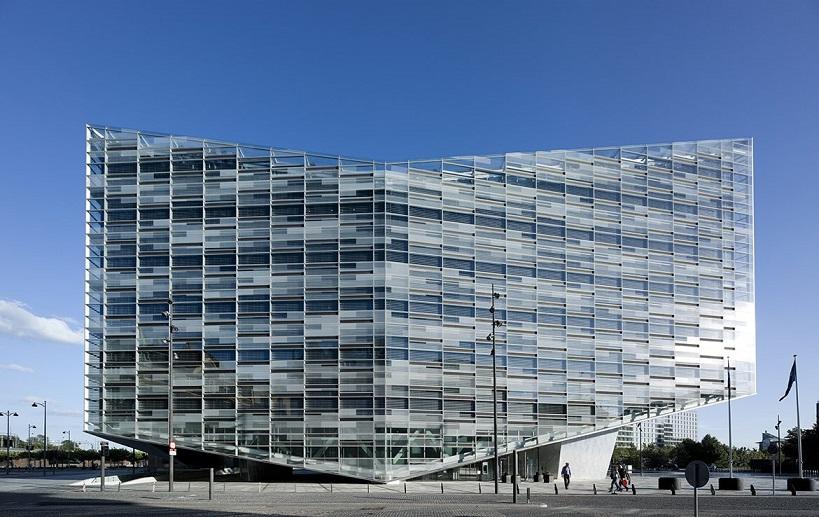
Scenario 1: The High-Altitude Wind Load
In cities like Chicago, the “Windy City” moniker is a literal engineering constraint. For a skyscraper, the glass at the 80th floor experiences vastly different pressures than at the 10th.
-
Constraint: Avoiding “glass flutter” and seal failure.
-
Decision Point: Increasing the thickness of the outer lite vs. using heat-strengthened glass.
-
Failure Mode: If the pressure equalization is not handled in the mullion design, water will be sucked into the building during a storm.
Scenario 2: The Urban Heat Island Effect
A glass building in a dense desert environment, such as Las Vegas or Phoenix, risks becoming a parabolic reflector.
-
Constraint: Managing “solar convergence” where the curved glass focuses heat on the street.
-
Second-Order Effect: Melting plastic components on nearby cars or causing pedestrian discomfort.
-
Resolution: Utilizing frosted or fritted glass patterns to break up reflections.
Planning, Cost, and Resource Dynamics
The financial planning for a flagship glass facade involves a “triple bottom line” analysis. Direct costs are often deceptive.
| Expense Category | Range (Per Sq Ft of Wall) | Influencing Factors |
| Standard Unitized | $150 – $300 | Grid size, standard finishes |
| Custom High-Perf | $350 – $600 | Curved glass, triple glazing, exotic coatings |
| Specialty/Point-Fix | $700 – $1,200+ | Stainless steel castings, oversized panes |
Indirect Costs and Opportunity: A high-performance facade may cost 20% more upfront but can reduce the size of the building’s HVAC plant by 30%. The opportunity cost of a “cheap” facade is often paid every month in utility bills and eventually in “carbon fines” imposed by modern city ordinances.
Tools, Strategies, and Support Systems
The maintenance of iconic glass facades usa relies on a hidden infrastructure.
-
Building Maintenance Units (BMU): Permanent rooftop cranes designed specifically for the building’s geometry.
-
Sensors (IoT): Integrated moisture sensors within the mullion cavities to detect leaks before they reach the drywall.
-
Dynamic Glazing (Electrochromic): Glass that tints on demand, eliminating the need for blinds.
-
Bird-Safe Fritting: Essential for compliance in many U.S. states to prevent avian collisions.
-
Thermal Imaging: Used during commissioning to find gaps in the insulation (the “thermal signature”).
Risk Landscape and Failure Modes
The failure of a glass facade is rarely about the glass breaking. It is usually a failure of the system.
-
Seal Failure (Desiccant Saturation): Once the seal of an Insulated Glass Unit (IGU) fails, moisture enters the cavity, creating a permanent fog.
-
Nickel Sulfide Spontaneous Breakage: Tiny impurities in tempered glass can expand over time, causing a pane to shatter without warning.
-
Galvanic Corrosion: When two dissimilar metals (like aluminum and stainless steel) touch without a thermal break, the weaker metal corrodes, compromising the structural integrity.
Governance, Maintenance, and Long-Term Adaptation
A facade is a living system. Long-term authority over a building’s performance requires a rigorous maintenance cycle.
Annual Review Checklist
-
Gasket Inspection: Check for shrinkage or brittleness in EPDM gaskets.
-
Sealant Elasticity: Test structural silicone for “adhesion loss.”
-
Drainage (Weep Holes): Ensure the internal drainage paths are clear of debris and nests.
-
Torque Testing: On point-supported systems, checking the tension of the bolts is a critical safety requirement.
Measurement, Tracking, and Evaluation
How do we define the success of iconic glass facades usa? We look at specific indicators:
-
Lagging Indicator: Energy consumption per square foot over a 5-year period.
-
Leading Indicator: The number of “hot/cold” complaints from tenants near the perimeter.
-
Qualitative Signal: The “Reflectivity Index”—how the building integrates with the surrounding neighborhood’s light profile.
Documentation Example: A “Façade Logbook” should track every pane replacement, noting the specific batch and coating type to ensure visual consistency 20 years down the line.
Common Misconceptions and Oversimplifications
-
“Triple glazing is always better”: In some U.S. climates, the added weight and cost of triple glazing never achieve a ROI compared to high-quality double glazing with a low-E coating.
-
“Glass is a poor insulator”: Modern vacuum-insulated glass (VIG) can rival the R-value of a solid stud wall.
-
“Reflective glass is for privacy”: While it provides daytime privacy, at night, the effect reverses, making the interior a fishbowl.
-
“Glass buildings are bird killers”: Modern fritting and UV-patterned glass make these buildings highly visible to birds while remaining transparent to humans.
Synthesis and Future Adaptability
The future of iconic glass facades usa lies in “active” envelopes. We are moving away from static barriers toward skins that breathe, generate power via integrated photovoltaics, and adjust their transparency based on the sun’s position.
The “iconic” building of the next decade will not be the one that shines the brightest, but the one that manages its environmental footprint with the most sophistication. As we refine our understanding of material limits and climate demands, the American glass facade remains a testament to the balance between the human desire for a view and the engineering necessity of protection. The transparency of our cities is not a finished product, but a continuing evolution of chemistry, physics, and design.