Luxury Coastal Glazing USA: A Technical & Architectural Pillar
The intersection of high-end residential architecture and the volatile maritime environment presents a unique set of engineering challenges that transcend mere aesthetics. In the United States, coastal regions—from the hurricane-prone Atlantic seaboard to the corrosive salt-mists of the Pacific Northwest—demand a specialized approach to transparency. Luxury Coastal Glazing USA. Luxury, in this context, is not just about the size of the glass pane; it is about the invisible performance characteristics that allow a structure to remain both open to the horizon and impervious to the elements.
Designing for the coast requires a departure from standard inland glazing logic. The primary adversary is a compounding force of high wind loads, cyclic pressure, and the relentless chemical assault of airborne chlorides. When these factors meet the modern architectural desire for “limitless” views and minimal framing, the structural requirements become immense. A failure to account for the specific micro-climate of a coastal site can lead to rapid degradation of sealants, etching of glass surfaces, and the catastrophic failure of hardware within a fraction of its intended lifespan.
This pillar article examines the technical landscape of high-performance glass in the American coastal market. It moves beyond the marketing veneer of “impact-rated” windows to explore the deeper mechanics of structural silicone, laminated interlayers, and metallurgical selection. For the homeowner, architect, or developer, understanding these nuances is the difference between a generational asset and a recurring liability.
Understanding “luxury coastal glazing usa”
To accurately define luxury coastal glazing usa standards, one must dismantle the oversimplification that “impact glass” is a singular solution. In the professional editorial sense, luxury glazing is an integrated system where the glass, the frame, the sealant, and the installation substrate function as a single, resilient unit. The “luxury” component refers specifically to the ability to achieve high-performance metrics—such as massive spans and ultra-thin sightlines—without compromising on the rigorous High-Velocity Hurricane Zone (HVHZ) requirements or Title 24 energy standards.
The primary misunderstanding in the market is the belief that a high price tag or a specific brand name guarantees coastal longevity. Many premium products designed for inland luxury fail prematurely when exposed to the high-salinity environment of the Florida Keys or the rugged cliffs of Malibu. A truly luxury coastal system is defined by its “passive resistance”—the ability to withstand environmental stress without frequent mechanical intervention.
Furthermore, there is a risk in over-emphasizing impact resistance at the expense of thermal performance. In the U.S., many coastal areas are also subject to extreme solar heat gain. A glass unit that can withstand a 2×4 projectile at 50 feet per second but lacks a sophisticated Low-E coating will result in an unlivable interior climate. The “best” systems are those that achieve a delicate balance between mechanical toughness and atmospheric intelligence.
Contextual Background: The Evolution of the Coastal Envelope
Historically, coastal architecture in the U.S. relied on small, shuttered openings to protect against storms. The “glass house” on the beach was an impossibility until the late 20th century. Two major shifts changed this trajectory: the development of SentryGlas (ionoplast interlayers) and the refinement of High-Velocity Hurricane Zone (HVHZ) building codes following Hurricane Andrew in 1992.
Andrew served as a catalyst for a systemic overhaul of how we think about glazing in the U.S. It proved that the “breach” of a single window could lead to the internal pressurization and eventual destruction of an entire roof system. This led to a bifurcated market: standard residential windows and “Coastal Grade” systems. Today, the luxury market has pushed these boundaries even further, utilizing “Jumbo” glass sizes that were previously only seen in commercial skyscrapers, adapted for the refined finish of a private residence.
Conceptual Frameworks for Maritime Durability
The “Sacrificial Layer” Mental Model
In this framework, the exterior surface of the glazing is viewed as a sacrificial barrier. While glass is relatively inert, the coatings and sealants are not. Specifying “Diamond-like Carbon” (DLC) coatings or specialized easy-clean polymers allows the glass to resist the “pitting” that occurs when salt crystals dry and are buffeted by sand-laden winds.
The “Cyclic Loading” Framework
Unlike a single impact, coastal glazing must withstand the “fatigue” of thousands of pressure cycles during a prolonged storm. A mental model that prioritizes the “elastic memory” of the sealant and frame ensures the system won’t “leak” air after the first hour of a 12-hour hurricane event.
The Metallurgy of Corrosion
One must assume that any metal exposed to the coast will eventually oxidize. The mental model here is to move from “protected” metals (painted or coated aluminum) to “inherently stable” metals (marine-grade 316 stainless steel or architectural bronze) for all hardware and fasteners.
Categories of Coastal Glazing Systems
Selecting a system involves navigating the trade-offs between visual transparency and structural bulk.
| Category | Primary Benefit | Significant Trade-off | Ideal Use Case |
| Thermally Broken Bronze | Highest corrosion resistance; timeless patina. | Extreme weight; requires massive structural headers. | Heritage-style oceanfront estates. |
| Marine-Grade Aluminum | Lightweight; allows for ultra-thin “invisible” frames. | High thermal conductivity; potential for galvanic corrosion. | Modern minimalist Pacific villas. |
| Structural Glass Fins | Maximum transparency; no horizontal mullions. | High cost; complex installation; difficult to replace. | Flagship luxury viewing galleries. |
| Ionomer Laminated (SentryGlas) | Exceptional toughness; remains clear after impact. | Stiffer than PVB; requires precision in edge sealing. | HVHZ (Florida/Gulf Coast) luxury. |
Real-World Scenarios Luxury Coastal Glazing USA
Scenario 1: The “Salt-Spray” Etching
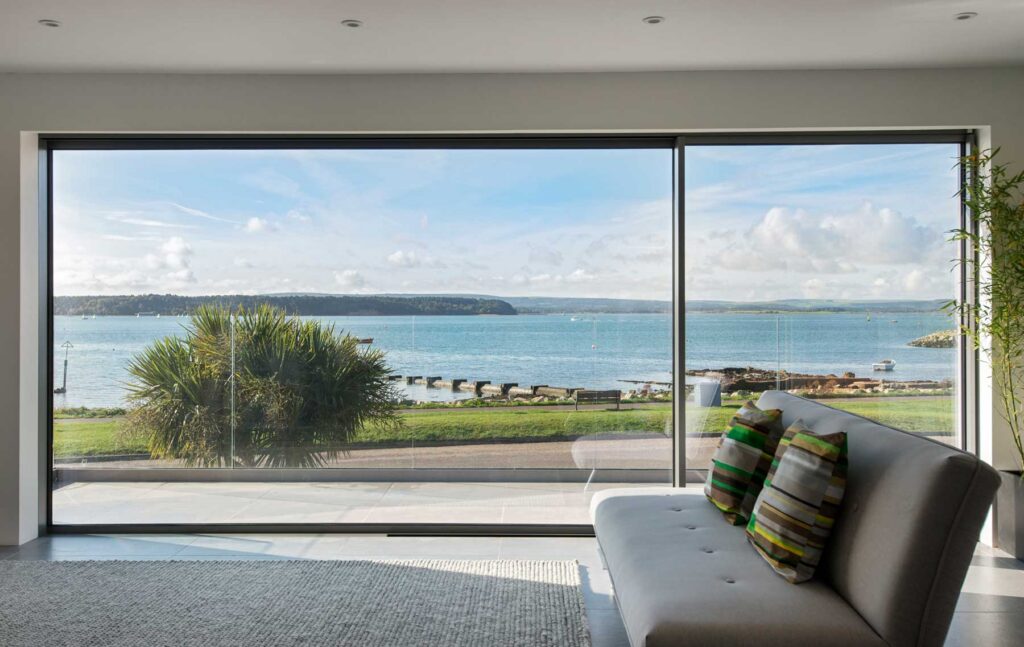
A residence in Newport, RI, features large clear spans. Over three years, the lower panes develop a “milky” haze that cannot be cleaned. The failure mode was a lack of a hydrophobic coating on the exterior surface. The second-order effect is a 30% reduction in the property’s aesthetic value and a high-cost replacement of the Insulated Glass Units (IGUs).
Scenario 2: Galvanic Corrosion of Hardware
In a Malibu renovation, stainless steel screws were used to secure aluminum tracks. The salt air acted as an electrolyte, causing the aluminum to “sacrifice” itself to the steel. Within five years, the tracks became pitted and the sliding doors ceased to function. The fix requires a complete tear-out of the threshold.
Planning, Cost, and Resource Dynamics
The “Coastal Premium” is a reality of the U.S. market. Expect costs to be 50% to 150% higher than equivalent inland luxury systems.
| Component | Cost Impact | Logic |
| Glass Thickness | +25-40% | Required for wind-load deflection limits. |
| Interlayer Type | +30-50% | Ionoplast (SentryGlas) vs. Standard PVB. |
| Finish/Coating | +15-20% | Kynar 500 or Class 1 Anodizing for salt resistance. |
Risk Landscape and Failure Modes
-
Delamination: The “clouding” of the edges of laminated glass, often caused by the use of incompatible acetic-cure silicones that react with the interlayer.
-
Thermal Stress Cracks: In high-performance coastal glass, the dark “frit” or heavy tinting can lead to heat absorption that exceeds the glass’s edge strength.
-
Hardware Binding: Salt crystallization inside the roller tracks of “multi-slide” doors, leading to mechanical failure of the motor or manual strain.
Governance, Maintenance, and Long-Term Adaptation
A “set and forget” mentality is the primary cause of failure in luxury coastal glazing usa projects.
-
Quarterly “Sweet-Water” Rinse: The most effective strategy is a simple rinse with deionized water to remove salt crystals before they can bond to the surface.
-
Sealant Inspection (Annual): Checking the “structural bite” of the silicone for signs of pull-away from the frame.
-
Hardware Lubrication: Using dry-film lubricants (PTFE) that do not attract the sand and grit common in coastal environments.
Measurement and Performance Evaluation
Success is measured through both leading and lagging indicators:
-
Leading: Air infiltration rates (measured in CFM/sq ft) during a simulated pressure test.
-
Lagging: The absence of “whistling” during high-wind events; no visible condensation inside the IGU cavity after a five-year period.
Common Misconceptions
-
“Impact glass is bulletproof.” It is not; it is designed to stay in the frame to prevent internal pressurization, not to remain pristine after a strike.
-
“All aluminum is the same.” 6063-T6 aluminum with a high-performance coating is vastly different from the “builder-grade” extrusions found in big-box stores.
-
“Tinting replaces the need for Low-E.” Tinting only addresses glare; Low-E addresses the actual transfer of heat energy.
Conclusion
The pursuit of the perfect coastal view is a battle against the physics of the maritime environment. In the United States, where coastal density continues to rise alongside environmental volatility, the mastery of glazing technology is no longer optional. A luxury residence on the water is a machine for living, and the glass is its most vulnerable and vital component. By prioritizing structural integrity, chemical compatibility, and a rigorous maintenance cadence, the “glass wall” becomes a permanent, transparent sanctuary rather than a temporary luxury.