Definitive Guide: Compare Switchable Smart Glass Plans & Technologies
The intersection of material science and interior architecture has reached a transformative juncture with the maturation of switchable glazing. Once a futuristic novelty reserved for speculative high-tech headquarters, the ability to modulate the opacity or tint of glass via electrical stimulus has become a critical tool for managing privacy, thermal loads, and the psychological health of building occupants. Compare Switchable Smart Glass Plans. This technology effectively deconstructs the traditional binary of “open” or “closed,” replacing it with a spectrum of transparency that can be tuned to the specific needs of a moment.
Integrating these systems into a commercial or residential environment is not, however, a simple matter of selecting a glass substrate. It is an exercise in complex electrical engineering, chemistry, and structural integration. The “smart” component of the glass is typically a multi-layered thin film—often containing liquid crystals or electrochromic ions—sandwiched between conductive coatings and protective glass lites. This assembly must remain hermetically sealed and electronically viable over decades of use, all while subject to the mechanical stresses of building movement and UV degradation.
As project stakeholders attempt to evaluate various market offerings, they are often confronted with a fragmented landscape of proprietary acronyms and divergent performance metrics. To effectively navigate this space, one must move past the aesthetic allure of “instant privacy” and interrogate the underlying physics of the different technologies. The choice between Polymer Dispersed Liquid Crystal (PDLC), Electrochromic (EC), and Suspended Particle Device (SPD) systems involves significant trade-offs in power consumption, switching speeds, and long-term durability.
Compare switchable smart glass plans
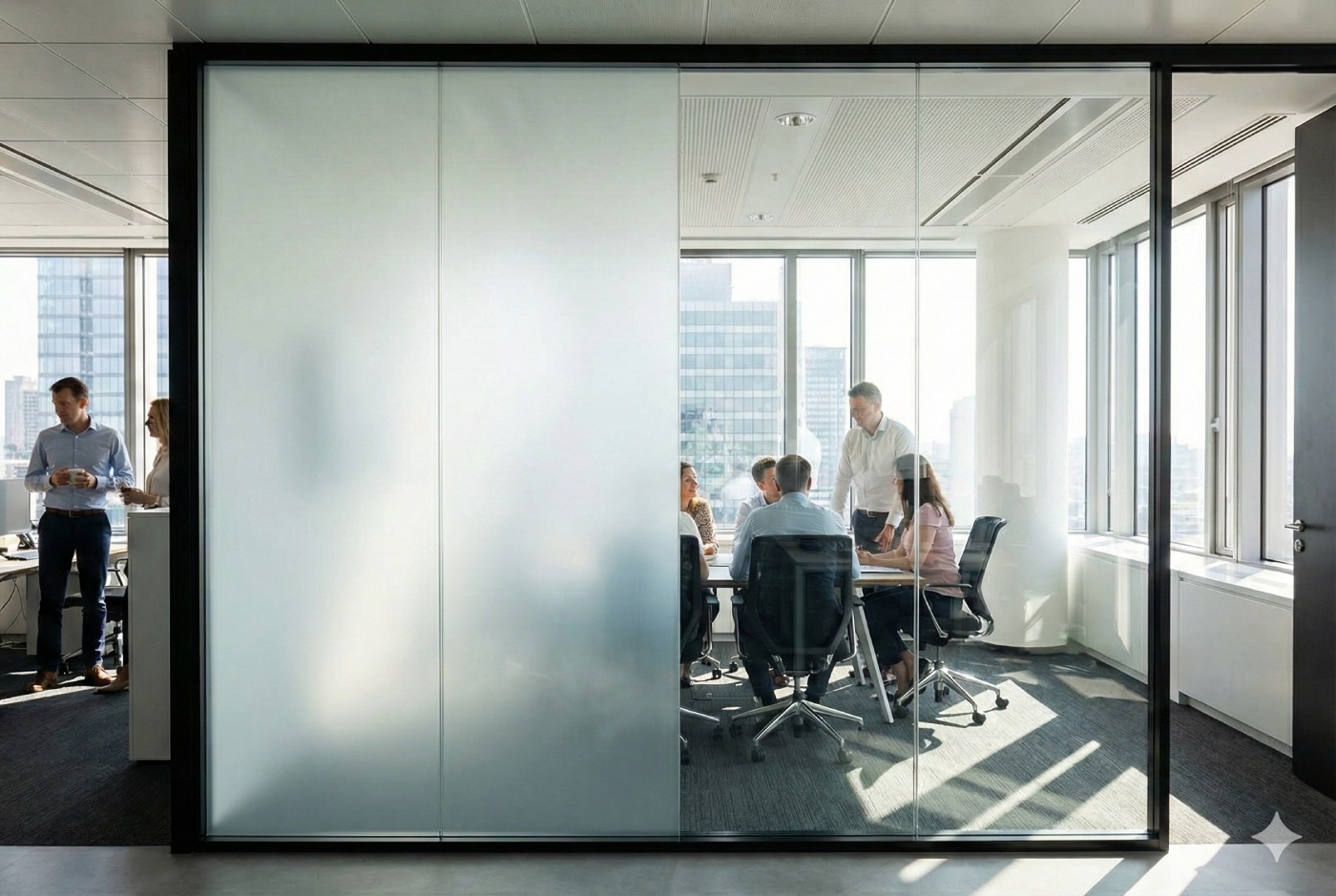
To effectively compare switchable smart glass plans, a professional must recognize that “smart glass” is an umbrella term for distinct chemical processes that solve different architectural problems. A common misunderstanding in the planning phase is the assumption that all switchable glass provides both privacy and solar control. In reality, the two primary market leaders—PDLC and EC—function in nearly opposite ways. PDLC provides privacy by scattering light (turning the glass milky white) but does not significantly block heat. EC, conversely, tints the glass to block solar heat gain but does not offer true privacy in its darkened state.
Comparing these plans requires a multi-perspective analysis that looks at the “state of rest.” For instance, some technologies are opaque when the power is off (fail-safe private), while others are transparent when off. This distinction is critical for emergency egress requirements and energy consumption profiles. A plan optimized for a medical consultation room, where privacy must be the default during a power failure, will look fundamentally different from a plan for a skyscraper’s western facade, where the priority is heat rejection during peak sun.
Oversimplification in these plans often occurs in the “low-voltage infrastructure” segment. Smart glass is an electrical appliance. A rigorous plan must account for transformer locations, wire gauges to prevent voltage drops over long glass spans, and the integration with Building Management Systems (BMS). When you compare switchable smart glass plans, the superior option is usually the one that provides a comprehensive “wiring and controls” schematic rather than just a per-square-foot glass cost.
Evolution of Chromogenic Glazing Systems
The concept of “chromogenic” glass—materials that change color or transparency in response to a stimulus—began in the mid-20th century with photochromic lenses that reacted to UV light. However, architectural needs demanded “user-controlled” changes. The development of Polymer Dispersed Liquid Crystal (PDLC) in the 1980s was the first major leap, utilizing the same principles as early digital watches to create “privacy on demand.”
The 1990s and 2000s saw the rise of Electrochromic (EC) glazing, which utilized a chemical reaction (ion transfer) to darken the glass. This was a response to the “glass box” skyscraper trend, providing a way to manage the massive cooling loads of all-glass buildings without the need for mechanical blinds. Today, the industry is moving toward “multimodal” glass that can both tint and scatter light, though these hybrid systems remain in the premium tier of architectural specifications.
Conceptual Frameworks and Mental Models
To evaluate switchable systems, one should utilize these three analytical lenses:
-
The “Haze vs. Clarity” Spectrum: Every smart glass has a baseline “haze” percentage even in its clear state. This model prioritizes the optical clarity required for the specific view—e.g., a boardroom versus a high-end retail window.
-
The Switching Velocity Model: PDLC switches in milliseconds; EC can take several minutes to fully tint. This model matches the technology to the human experience of the space.
-
The “Passive-Active” Energy Balance: This framework calculates whether the electricity required to power the glass is offset by the savings in HVAC and lighting costs.
Primary Technology Categories and Variations
Selecting the right plan involves a technical comparison of the three dominant active glazing technologies.
1. Polymer Dispersed Liquid Crystal (PDLC)
The most common “privacy glass.” It consists of liquid crystal droplets dispersed in a polymer matrix. When power is applied, the crystals align, allowing light to pass through.
-
Best for: Conference rooms, bathrooms, and interior partitions.
-
Trade-off: Does not provide solar heat control; can have a “milky” appearance when viewed at an angle.
2. Electrochromic (EC)
A multi-layered ceramic coating that moves lithium ions between layers when a small voltage is applied, changing the glass from clear to a deep blue or gray tint.
-
Best for: Skyscraper facades and skylights.
-
Trade-off: Slow switching speed; does not provide frosted privacy.
3. Suspended Particle Device (SPD)
Utilizes a thin film containing microscopic particles that align when electrified. Unlike PDLC, it can be dimmed to various levels of light transmission.
-
Best for: High-end automotive, aviation, and premium residential.
-
Trade-off: High cost; often requires constant power to remain clear.
Comparison Table: Performance Metrics
| Feature | PDLC | Electrochromic | SPD |
| Switching Speed | Milliseconds | 3–10 Minutes | Seconds |
| Power-Off State | Opaque (Usually) | Clear (Usually) | Dark (Usually) |
| Solar Control | Minimal | Exceptional | High |
| Operating Voltage | 48–110V AC | 3–5V DC | 60–110V AC |
| Primary Goal | Privacy | Energy Efficiency | Glare/Light Control |
Detailed Real-World Scenarios Compare Switchable Smart Glass Plans
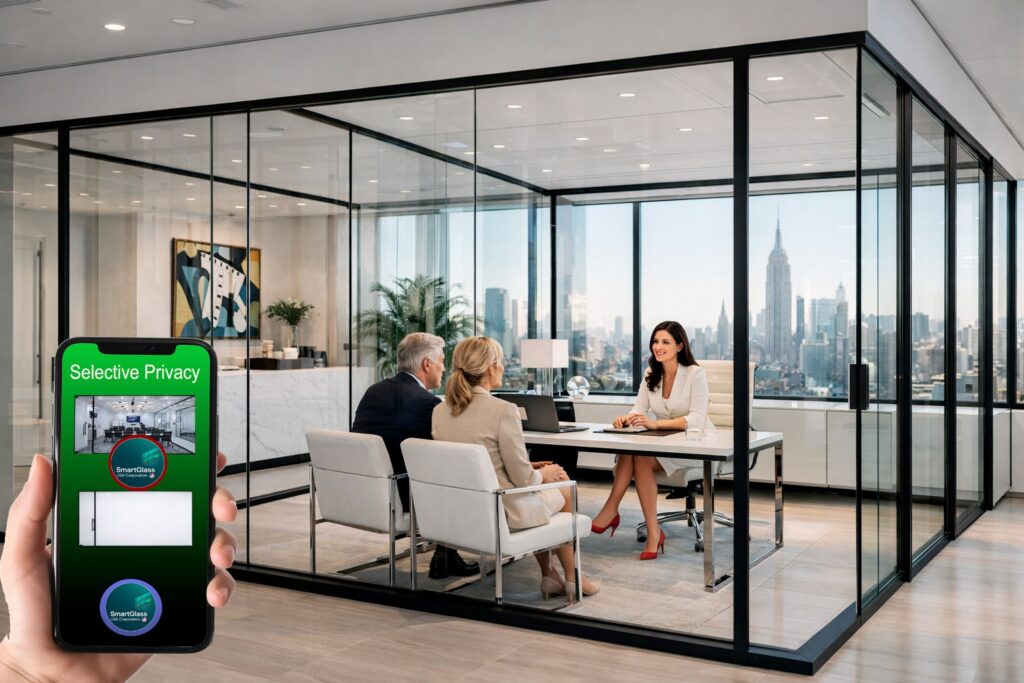
Scenario A: The Modern ICU (Healthcare)
In a hospital setting, traditional curtains are a major vector for hospital-acquired infections (HAIs). A PDLC switchable glass plan here eliminates the need for fabric. The failure mode to avoid is “intermittent flicker”; the electrical plan must include stabilized power supplies to ensure that the patient’s privacy doesn’t vanish during a hospital-wide power surge or generator test.
Scenario B: The Western Facade Office Tower
The goal is to eliminate glare on computer screens without losing the view. An Electrochromic plan is the clear choice. The planning must account for “zoning”; the glass near the ceiling may need to tint deeper than the glass at desk height to allow natural light deep into the floor plate while protecting the occupants from direct solar glare.
Planning, Cost, and Resource Economics
The financial plan for smart glass is often misunderstood as a “premium window cost.” In reality, it is an infrastructure investment that impacts the glazing budget, the electrical budget, and the HVAC sizing.
| Cost Element | Relative Impact | Variability |
| Glass Fabrication | High | Laminated vs. IGU configurations |
| Electrical Control Units | Moderate | IP-addressable vs. simple switches |
| Field Wiring (Labor) | Moderate | Distance to power sources |
| Energy Savings | Long-term Gain | Reduction in cooling loads (EC only) |
Risk Landscape and Failure Modes
The “smart” part of the glass is also its most vulnerable.
-
Bus-Bar Arcing: If the electrical connection to the film (the bus-bar) is poorly executed, it can arc, causing a permanent black burn mark in the corner of the glass.
-
Delamination: Moisture entering the edge of the glass can cause the smart film to separate from the glass lites. This is particularly risky in “wet” environments like bathrooms.
-
UV “Yellowing”: Early iterations of smart films would yellow over time. Modern plans must specify UV-stable interlayers to prevent this degradation.
Governance, Maintenance, and Long-Term Adaptation
Smart glass is a “dynamic” asset that requires a different maintenance philosophy than static glass.
Layered Maintenance Checklist:
-
Inverter/Transformer Audit: Annual check of the electrical outputs to ensure they remain within the manufacturer’s specified voltage range.
-
Sealant Inspection: Verification that the structural silicone at the edges is intact, preventing moisture ingress.
-
Controller Programming: Updating the logic of the BMS to ensure the glass is tinting at the correct times of year as solar angles shift.
Common Misconceptions
-
“Smart glass uses a lot of electricity.” PDLC uses roughly 3–5 watts per square meter—less than a standard LED light bulb.
-
“I can just apply a film to my existing windows.” While “retrofit” films exist, they are significantly less durable than factory-laminated smart glass and are prone to peeling at the edges.
-
“It’s only for privacy.” As seen with EC glass, the primary driver for many high-rise projects is actually “solar control,” which can reduce building-wide energy costs by up to 20%.
Conclusion
The decision to compare switchable smart glass plans marks a transition toward a more responsive, intelligent building envelope. The technology has matured to the point where it is no longer a question of “if” it works, but “which” chemistry is right for the specific architectural intent. Success in these projects requires the intellectual honesty to prioritize function over the “magic” of the switch. Whether it is the instant opacity of PDLC for a private boardroom or the gradual thermal shielding of Electrochromic glass for a sustainable skyscraper, the value lies in the glass’s ability to adapt. As we look toward the future, the integration of these systems will become the baseline for any space that seeks to balance human comfort with environmental responsibility.